

If you’d told me a decade ago that I’d be collaborating with an algorithm to outline a research paper, I’d have laughed. Back then, my study assistant was a stack of highlighters, a pot of strong coffee, and the quiet desperation of a library at midnight. Today, the landscape has shifted so dramatically that it’s almost unrecognizable. The rise of AI study assistant tools isn’t just a minor upgrade; it’s a fundamental change in how we learn, research, and retain information.
I’ve spent the last year not just reading about these tools, but actively using them, testing their limits, celebrating their efficiencies, and confronting their pitfalls. This isn’t a theoretical exercise; it’s a hands-on exploration of a new educational frontier. Let’s cut through the hype and talk about what these tools really are, how they work, and how to use them without losing your intellectual edge.
Beyond the Hype: What Are AI Study Assistants, Really?

At their core, AI study assistants are sophisticated software powered by Large Language Models (LLMs) and machine learning. Think of them as a hyper-efficient, endlessly patient, and incredibly well-read study partner. They don’t think or understand in the human sense, but they are exceptionally good at processing vast amounts of text, identifying patterns, and generating human-like responses
Their functions are diverse and ever-evolving:
- Summarization & Explanation: Paste a dense academic article or a chapter of Leviathan by Thomas Hobbes, and the AI can distill the key arguments into a few bullet points or explain the concept of the state of nature in simpler terms.
- Question Generation & Practice: Stuck on a topic? Ask the AI to generate practice questions, from multiple-choice quizzes to essay prompts, complete with model answers.
- Research & Brainstorming: Need to start a paper on climate change policy? The AI can outline potential angles, suggest relevant scholars, and even draft a preliminary thesis statement.
- Writing & Editing Assistance: It can help rephrase awkward sentences, check for grammatical errors, and improve the flow of your writing, acting as a supercharged grammar checker.
- Language Learning: By conversing in the target language or explaining grammatical nuances, it provides a low-pressure environment for practice.
A Practical Case Study: The History Paper
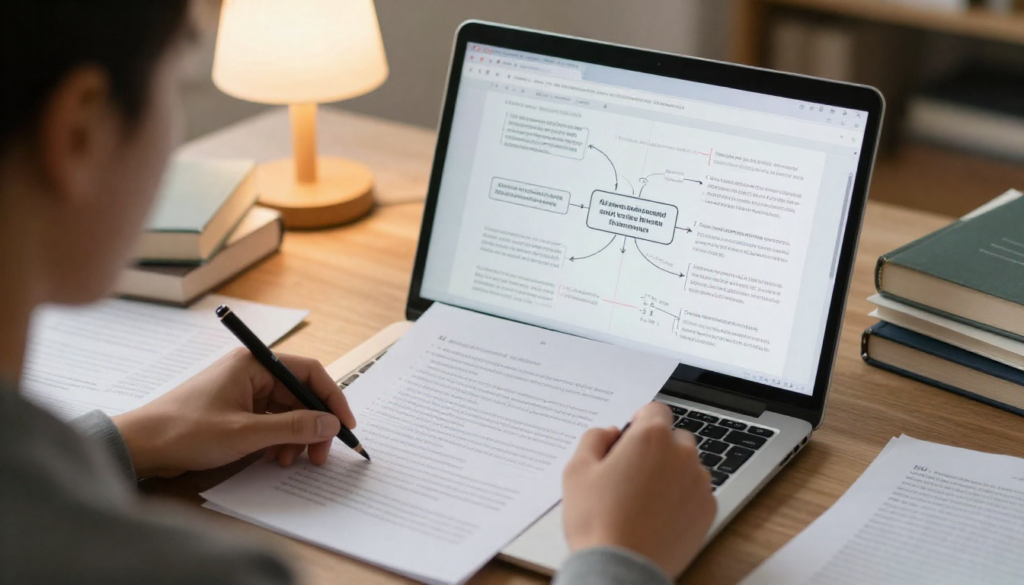
Let me illustrate with a real-world example. Last month, I was helping a student (let’s call him Ben) with a paper on the economic causes of the Roman Empire’s fall. Ben was overwhelmed by the primary sources and secondary literature.
- The Brainstorming Hurdle: Ben knew he needed a unique angle. Instead of staring at a blank page, he prompted the AI: “Generate three unconventional thesis statements about the economic decline of the Roman Empire, focusing on trade routes and currency inflation.” The AI provided several options, one of which sparked Ben’s interest: the role of debased currency in disrupting long-distance trade. This gave him a starting point.
- The Research Labyrinth: Ben had three key academic papers, but struggled to synthesize them. He fed the papers (or their abstracts and key sections) into the AI and asked for a comparative analysis of their main arguments. The AI produced a concise table highlighting each author’s perspective on inflation’s impact. This didn’t replace Ben’s reading; it structured his understanding, allowing him to engage with the texts more critically.
- The Writing Block: Ben had an outline but was stuck on the introduction. He used the AI to draft a few versions, blending historical context with his unique thesis. He then heavily edited the output, injecting his own voice and ensuring the argument was authentically his.
The result? Ben produced a stronger, more coherent paper in half the time. The AI didn’t write it for him; it functioned as a catalyst for his own thinking.
The Bright Side: Efficiency and Accessibility

The benefits are tangible and profound.
- Democratizing Education: For students who can’t afford expensive tutors, these tools provide 24/7 personalized support. A student struggling with calculus at 2 AM now has a resource to explain a concept in multiple ways.
- Overcoming Learning Barriers: For neurodivergent learners or those with language barriers, AI can simplify complex texts and provide structured learning aids that traditional classrooms might not offer.
- Augmenting, Not Replacing, Human Effort: The most successful users, like Ben, treat AI as a sparring partner. It challenges their assumptions, fills in knowledge gaps, and frees up cognitive energy for higher-order thinking analysis, synthesis, and creativity.
The Shadow Side: Critical Limitations and Ethical Quagmires

However, my experience has also revealed significant dangers. Blind reliance on these tools is a recipe for intellectual stagnation.
- The Hallucination Problem: AI models can confidently generate completely false information, a phenomenon known as hallucination. I once asked an AI about a specific historical event, and it fabricated a detailed account with non-existent sources. You must always verify the information. The AI is a starting point for research, not the final authority.
- Erosion of Critical Skills: If you let the AI outline every essay and summarize every text, your own ability to synthesize information and construct an argument will atrophy. It’s like using a calculator for every simple math problem; you eventually lose your mental arithmetic skills.
- Academic Integrity and Plagiarism: This is the elephant in the room. Submitting AI-generated text as your own is plagiarism, and most institutions are developing sophisticated tools to detect it. The ethical line is clear: AI is a tool for assistance, not a ghostwriter. The goal is to learn, not to outsource thinking.
- Data Privacy: When you paste your unpublished research, personal reflections, or sensitive data into these platforms, you are often feeding a corporate machine. Understand the terms of service. What happens to your data? It’s a question too few students ask.
A Balanced Approach: How to Use AI Study Assistants Ethically and Effectively

Based on my hands-on experience, here’s a framework for integrating these tools into your learning journey responsibly:
- Be the Conductor, Not the Audience: You are the director; the AI is your orchestra. It plays the notes you give it. Your prompts must be specific, critical, and guided by your learning objectives. Don’t ask, “Explain WWII.” Ask, “Explain the key economic factors that led to the U.S. entering WWII, focusing on the Lend-Lease Act.”
- Use it for the “Grunt Work,” Not the “Deep Work”: Delegate tasks like summarizing long readings, generating study questions, or checking grammar. Protect your time and mental energy for the deep work: formulating original ideas, engaging in debate, and creating novel connections.
- Cultivate a Healthy Skepticism: Treat every AI output with a healthy dose of doubt. Cross-reference facts, check sources, and challenge the AI’s conclusions. This practice itself is a valuable critical thinking exercise.
- Prioritize Understanding Over Speed: The goal is to learn, not just to complete assignments. If you use an AI to understand a concept, try to explain it back in your own words without looking at the screen. This active recall solidifies learning.
The Future is a Partnership
AI study assistants are not a fad; they are a permanent fixture in the educational landscape. The genie is out of the bottle. The question is no longer whether to use them, but how to use them wisely.
The most successful students of the future will be those who master the art of human-AI collaboration. They will be the ones who leverage AI’s computational power to handle information overload while fiercely guarding and developing their own uniquely human capacities for curiosity, creativity, and critical judgment. The tool is powerful, but the intellect, the ethics, and the ultimate responsibility will always remain firmly in human hands.
FAQs
Q1: Are AI study assistant tools considered cheating?
A: Using them to generate text you submit as your own is absolutely cheating and plagiarism. However, using them ethically for brainstorming, summarizing, practice questions, and grammar checking, where you remain the author of the final work, is widely accepted. Always check your institution’s specific academic integrity policy.
Q2: Can AI study assistants provide accurate, factual information?
A: They can be accurate, but they are not infallible. AI models are known to hallucinate or fabricate information. Always treat their output as a draft and verify critical facts and sources through reputable databases, textbooks, and scholarly articles.
Q3: What’s the best way to start using an AI study assistant?
A: Start with a low-stakes task. Use it to summarize a news article you’ve read or generate a practice quiz for a topic you’re familiar with. Learn how to craft clear, specific prompts. The quality of your output is directly tied to the quality of your input.
Q4: Do these tools work for all subjects?
A: They are most effective for text-based subjects like history, literature, social sciences, and language learning. They are less reliable for highly technical, visual, or mathematical subjects that require diagrams, complex equations, or hands-on experimentation, though they can still help explain underlying concepts.
Q5: What should I do if I suspect an AI has given me false information?
A: Immediately stop using that information. Conduct your own research using trusted sources like academic journals, official reports, and reputable news outlets. If you’re a student, discuss the discrepancy with your instructor; it shows critical engagement.

Related Posts