

Let’s be honest: the landscape of SEO content writing has shifted seismically in the last few years. I remember the days of meticulously stuffing keywords, building endless article directories, and hoping for the best. And right in the middle of this dance is a new partner: AI writing assistants. But not all AI tools are created equal. From my own work running content teams and consulting for agencies, I’ve found that the best ones aren’t just word generators, they’re collaborative partners that amplify human skill, not replace it.
The key mindset shift is this: stop looking for a tool that will write articles for you. That path leads to generic, often inaccurate, and easily spotted content that Google’s Helpful Content Update will swiftly demote. Instead, seek tools that streamline your research, overcome creative blocks, optimise structure, and ensure technical SEO soundness. Here’s a breakdown of the tools that have genuinely earned a spot in my workflow, categorised by the specific problems they solve.
For the Brainstorming & Strategy Phase: Clearing the Fog

Before a single word is written, you need a solid foundation. This is where Frase.io or MarketMuse shine. I’ve used both extensively, and they function like hyper-competent research assistants. You plug in a topic or keyword, and they don’t just spit out a list of related terms. They analyse the top-ranking pages, breaking down the semantic entities, questions, and subtopics your content must cover to be considered comprehensive.
It’s like getting a blueprint of what authority looks like for any given query. This moves you beyond guesswork and into data-driven content planning. For a recent client in the sustainable home goods space, using Frase revealed that top-performing articles all deeply addressed lifecycle analysis, a subtopic we hadn’t initially prioritised. That insight alone reshaped our entire content pillar.
For Beating the Blank Page & Drafting: The Creative Co-Pilot

This is the stage most people think of, and here, Jasper (formerly Jarvis) and Copy.ai were early leaders. However, my current go-to for sheer versatility and human-like flow is Claude by Anthropic. Its context window is massive, meaning you can feed it a detailed brief, your target keywords, and even a rough outline, and it will produce a coherent, surprisingly nuanced first draft. The magic isn’t in accepting its output verbatim, but in using it to jumpstart your process. Stuck on an introduction? Ask for three options in different tones.
Need to explain a complex concept simply? It can rephrase technical jargon into accessible language. A crucial tip: I always instruct these tools to write for an expert audience but explain clearly, and I provide specific examples of our brand’s voice. The output then becomes excellent raw material to refine, fact-check, and inject with genuine personal experience and unique anecdotesthe very things that build E-E-A-T.
For Optimisation & Precision: The SEO Editor
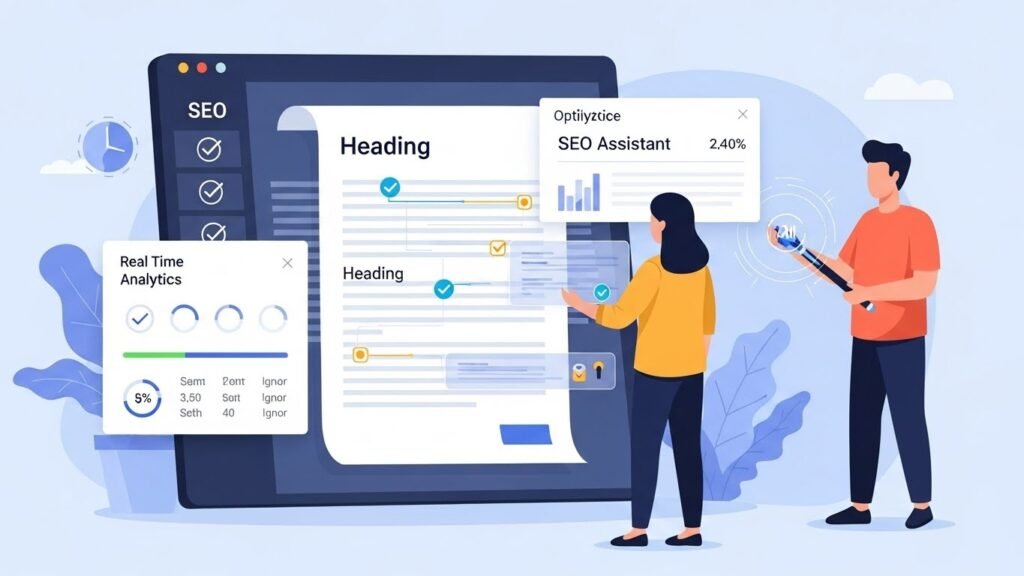
You have a solid draft. Now, does it tick all the SEO boxes? This is where Surfer SEO or Clearscope becomes indispensable in my toolkit. They act like real-time SEO editors. As you write (often in their native editors or via Google Docs integrations), they analyse your content against the current top 20 results, giving live feedback on keyword usage, semantic term inclusion, content length, and structure. They’ll nudge you if you’ve missed a key related term or if your heading structure could be improved for readability.
I treat their recommendations as guidelines, not gospel. Sometimes, their suggested optimal length is excessive, or a suggested keyword doesn’t fit contextually. I once used Surfer to optimise a product comparison guide; it flagged that we hadn’t mentioned a specific, long-tail feature question. We added a concise, helpful section addressing it, and that page saw a 15% increase in organic traffic within two months.
The Indispensable Human in the Loop: Ethical Considerations & Limitations

No discussion of these tools is complete without a heavy dose of realism. First, fact-checking is non-negotiable. AI is notoriously confident and often wrong about specifics, dates, statistics, and emerging information. I’ve seen it cite studies that don’t exist. Your expertise is the guardrail. Second, originality and perspective are everything. Google is getting frighteningly good at identifying AI-generated sludge.
The tools I rely on help me work faster and smarter, but the final product is always filtered through my experience, includes original case studies from my clients (with permission), and offers a balanced viewpoint. I might use Claude to help draft a section on the limitations of AI for SEO, which is a wonderfully meta way to ensure the content has inherent human critique built in.
Finally, voice and brand personality cannot be automated. An AI can mimic a style, but it cannot embody your brand’s unique stories, values, and customer interactions. That final polish, the turn of phrase, the relatable metaphor, the call-back to a company value is where you earn reader trust and loyalty.
The Bottom Line
The best AI tools for SEO content writing are those that augment the human writer’s strengths: strategic thinking, expertise, and authentic communication. My stack typically involves Frase for strategy, Claude for drafting, and Surfer for optimisation, but the constant is me editing, verifying, and injecting the humanity. Used wisely, these tools don’t threaten our craft; they free us from the drudgery to focus on what we do best: connecting, persuading, and building genuine authority.
FAQs
Q: Can I just use AI to write and publish articles without editing?
A: Absolutely not. This will almost certainly lead to factual errors, generic content, and poor SEO performance as search engines prioritise helpful, human-experience-driven content.
Q: Which is the single best “all-in-one” AI writing tool?
A: There isn’t a perfect one. Jasper and Copy.ai are strong all-rounders for marketing copy, but for deep SEO content, I prefer combining specialised tools: one for research (Frase), one for drafting (Claude), and one for optimisation (Surfer).
Q: Will Google penalise me for using AI tools?
A: Google states it rewards “helpful content,” regardless of how it’s created. The penalty comes from using AI to create unhelpful, mass-generated content designed to game search engines. If you use AI as an assistant to create better, more helpful content, you’re in the clear.
Q: How do I maintain a consistent brand voice with AI?
A: Provide the tool with extensive examples of your existing content, style guides, and specific instructions on tone, vocabulary, and sentence structure. Then, always edit the output to ensure it aligns perfectly with your brand’s personality.
Q: Are these tools cost-effective for a solo blogger or small business?
A: It depends. Many have tiered pricing. Start with a tool that addresses your biggest pain point (e.g., Surfer for optimisation if your drafts are strong, or an all-rounder like Jasper if you struggle with ideation and drafting). Consider them an investment in the quality and scalability of your content.

Related Posts